University of Pittsburgh Athletics

Love and Basketball
3/30/2023 2:30:00 PM | General, Women's Basketball
Love (CGS '01, EDUC '02G) grew up in Rochester, New York, with working class parents. Her mother managed a convenience store, and her father was a cab driver and worked at the airport. At the time, Rochester was an important port city on Lake Ontario and was home to several thriving companies. Because of that and her parents' connections to her community, Love learned an appreciation for the diversity of the region.
"It was just a wonderful time," she says. "I really loved growing up in Upstate New York. Black families had middle-class jobs. It was just a beautiful time. I grew up in a loving and thriving community of Black folks."
Love spent her childhood years drawing and dancing. At the age of 10, she picked up a basketball, and that was that.
"Once I found basketball, I did absolutely nothing other than play basketball," she says. "It was my love. I was a gym rat."
At age 12, Love began working at her gym, cleaning the toilets and floors and being paid under the table. Four years later, on her 16th birthday, she was officially hired by the gym.
When she entered Edison Career and Technology High School, Love's basketball skills and 6-foot-2 frame were noticed by the school's athletic director, Judi Knight, who helped to guide Love through the recruiting process when colleges came calling.
"She was everything to me. She really became like a second mom to me," Love says of Knight, who was known as an advocate for girls' sports in Upstate New York and who passed away in March of 2020 at the age of 79. "I don't think I would've gone to college or left Rochester without her. She was the one who really pushed me, got me SAT training and took me to college. She was my rock."
Knight helped Love to connect with Old Dominion University, which, at the time, was a powerhouse in women's college basketball, finishing second in the 1997 NCAA tournament.
"I was a kid from Upstate New York [who] had never been to the South before, but here we go: I'm in Virginia," she says. "It was beautiful, but I was having a culture shock being in a new place."
It didn't take Love long to realize that there were some inequities being practiced at Old Dominion and she was caught in the middle of them.
"By the end of my freshman year, I realized I was in classes with all of the male basketball players, and I was the only female basketball player," she says. "I didn't understand why."
She approached her teammates and asked them what classes they were taking.
Their responses? Premed, calculus, biology.
"I wondered why I wasn't taking any of those classes," she says, so she went to the school's administration and asked.
"They said, 'Well, you're an inner-city kid, went to an inner-city school and got terrible SAT scores, so this is your major: recreation and leisure.'
"I'm not saying that's a terrible major or putting a value statement on that, but that's not what I wanted to do. And they said, 'Well, that's it for you.'"
Love immediately got on the phone with Knight, who flew from New York to Virginia to speak with academic advisors and coaches.
"After that, she comes to me and says, 'Bettina, you can't stay here,'" Love explains. "I said, 'Where am I going to go?' And she said, 'Don't worry, I'll make some calls.'"
That's exactly what Knight did. She connected Love with Pitt coach Traci Waites, and in 1999, Love transferred to Pitt.
"[Waites] said, 'Here, you're going to be a student-athlete, and I truly mean that,'" Love says. "And I didn't know what that meant, but I knew that I wanted to go to college; I wasn't just there to be an athlete."
Her new coach had strict academic standards, with eight hours of mandatory study hall per week. If one player missed a minute, the team had to run a mile. Players learned quickly that tardiness would cost them.
"We all did like nine hours of study hall, because we didn't want any problems," Love jokes. "But I just started studying nonstop. And it became a beautiful experience. I just started reading a ton of books. I took my first [Africana] studies class at Pitt. I was a student for the very first time in my life. The institution just took care of me."
Love played in 53 games with the Panthers, scoring an average of seven points per game. She graduated in four years with a Bachelor of Arts degree in liberal studies and had an extra season of eligibility left. She elected to stay at Pitt to get a master's degree from the School of Education, with the University providing an academic scholarship to attend the graduate program during her final year of eligibility.
It was then that Love was first presented with the idea of one day becoming a full-time college professor. First, though, she became a teacher in Pittsburgh, then Miami. But she always felt that a path back to college was in the cards.
So, in 2004, Love applied to the PhD program in educational policy studies at Georgia State University.
"The rest is history," she says. "But it doesn't happen without Pitt."
Since then, Love has been an associate professor at Northern Kentucky University as well as an assistant professor and, most recently, Georgia Athletic Association Professor in Education at the University of Georgia.
Along the way, she found a new passion that didn't involve a basketball.
"I realized that something that brought me as much joy as basketball was writing," she says. "I see writing as a big puzzle. It just became another challenge."
Getting to take those Africana studies classes at Pitt greatly inspired her writing.
"The richness of Black people, the richness of our culture—it can be studied," Love says. "Something that was so near and dear to my heart was Black art, Black creativity and hip-hop."
Love took that passion and turned it into her first book, "Hip Hop's Li'l Sistas Speak: Negotiating Hip Hop Identities and Politics in the New South," which analyzes the relationship between Black girls and hiphop culture in the South.
Her second book, "We Want to Do More than Survive: Abolitionist Teaching and the Pursuit of Educational Freedom," turned her focus to the experience of Black people throughout the United States.
"Being Black in this country is to live in a perpetual-state survival mode, and that's no way to live," Love says of the book's theme.
She has another book set to be published next spring, titled "Punished for Dreaming," that details the last 40 years of educational reform in the United States.
"I never thought, in a million years, that I would be writing about education, Black people, Black culture and education policy and politics," she says. "I never thought that would come from the kid from Rochester, New York, who just wanted to play basketball."
Love's next journey will bring her back to her home state. She has accepted a position as the William F. Russell Endowed Chair at Columbia University's Teachers College and will begin her work there this fall.
It's quite an accomplishment for the young woman once pigeonholed into a major simply because of her background.
"Oftentimes, when you're labeled an inner-city kid, people don't see how amazing you are, how strong you are, how smart you are or how intelligent you are," Love says. "They take those labels and they run with it. And that's not it at all. Like any kid, we need guidance, love and support. We have gifts, and we need those gifts to be nurtured. My work has really tried to show people how brilliant Black folks are and how amazing Black communities are. What we need is support and for folks to see our humanity."
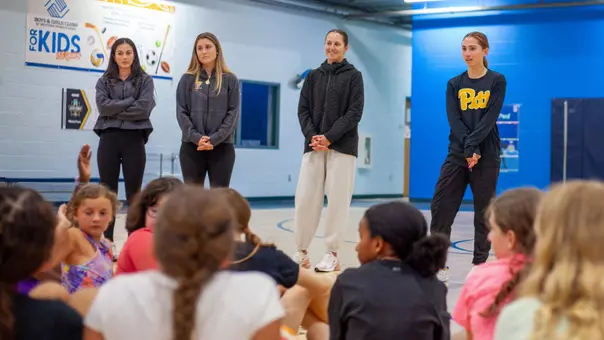
Love continues to give back to Pitt. She has formed a strong relationship with Michael Haas, director of development and alumni affairs in Pitt's School of Education and has served as a motivational speaker for Pitt's women's basketball team as well.
She has immense gratitude to Pitt, and to those like Knight, for viewing her in a light in which she didn't even see herself and for bringing out the best in her.
"It goes back to all the amazing people who saw something in me, who listened to me," she says. "That's why I'll always be indebted to the University of Pittsburgh. They were the first place that saw me as an athlete and a student—and more of a student."
"It was just a wonderful time," she says. "I really loved growing up in Upstate New York. Black families had middle-class jobs. It was just a beautiful time. I grew up in a loving and thriving community of Black folks."
Love spent her childhood years drawing and dancing. At the age of 10, she picked up a basketball, and that was that.
"Once I found basketball, I did absolutely nothing other than play basketball," she says. "It was my love. I was a gym rat."
At age 12, Love began working at her gym, cleaning the toilets and floors and being paid under the table. Four years later, on her 16th birthday, she was officially hired by the gym.
When she entered Edison Career and Technology High School, Love's basketball skills and 6-foot-2 frame were noticed by the school's athletic director, Judi Knight, who helped to guide Love through the recruiting process when colleges came calling.
"She was everything to me. She really became like a second mom to me," Love says of Knight, who was known as an advocate for girls' sports in Upstate New York and who passed away in March of 2020 at the age of 79. "I don't think I would've gone to college or left Rochester without her. She was the one who really pushed me, got me SAT training and took me to college. She was my rock."
Knight helped Love to connect with Old Dominion University, which, at the time, was a powerhouse in women's college basketball, finishing second in the 1997 NCAA tournament.
"I was a kid from Upstate New York [who] had never been to the South before, but here we go: I'm in Virginia," she says. "It was beautiful, but I was having a culture shock being in a new place."
It didn't take Love long to realize that there were some inequities being practiced at Old Dominion and she was caught in the middle of them.
"By the end of my freshman year, I realized I was in classes with all of the male basketball players, and I was the only female basketball player," she says. "I didn't understand why."
She approached her teammates and asked them what classes they were taking.
Their responses? Premed, calculus, biology.
"I wondered why I wasn't taking any of those classes," she says, so she went to the school's administration and asked.
"They said, 'Well, you're an inner-city kid, went to an inner-city school and got terrible SAT scores, so this is your major: recreation and leisure.'
"I'm not saying that's a terrible major or putting a value statement on that, but that's not what I wanted to do. And they said, 'Well, that's it for you.'"
Love immediately got on the phone with Knight, who flew from New York to Virginia to speak with academic advisors and coaches.
"After that, she comes to me and says, 'Bettina, you can't stay here,'" Love explains. "I said, 'Where am I going to go?' And she said, 'Don't worry, I'll make some calls.'"
That's exactly what Knight did. She connected Love with Pitt coach Traci Waites, and in 1999, Love transferred to Pitt.
"[Waites] said, 'Here, you're going to be a student-athlete, and I truly mean that,'" Love says. "And I didn't know what that meant, but I knew that I wanted to go to college; I wasn't just there to be an athlete."
Her new coach had strict academic standards, with eight hours of mandatory study hall per week. If one player missed a minute, the team had to run a mile. Players learned quickly that tardiness would cost them.
"We all did like nine hours of study hall, because we didn't want any problems," Love jokes. "But I just started studying nonstop. And it became a beautiful experience. I just started reading a ton of books. I took my first [Africana] studies class at Pitt. I was a student for the very first time in my life. The institution just took care of me."
Love played in 53 games with the Panthers, scoring an average of seven points per game. She graduated in four years with a Bachelor of Arts degree in liberal studies and had an extra season of eligibility left. She elected to stay at Pitt to get a master's degree from the School of Education, with the University providing an academic scholarship to attend the graduate program during her final year of eligibility.
It was then that Love was first presented with the idea of one day becoming a full-time college professor. First, though, she became a teacher in Pittsburgh, then Miami. But she always felt that a path back to college was in the cards.
So, in 2004, Love applied to the PhD program in educational policy studies at Georgia State University.
"The rest is history," she says. "But it doesn't happen without Pitt."
Since then, Love has been an associate professor at Northern Kentucky University as well as an assistant professor and, most recently, Georgia Athletic Association Professor in Education at the University of Georgia.
Along the way, she found a new passion that didn't involve a basketball.
"I realized that something that brought me as much joy as basketball was writing," she says. "I see writing as a big puzzle. It just became another challenge."
Getting to take those Africana studies classes at Pitt greatly inspired her writing.
"The richness of Black people, the richness of our culture—it can be studied," Love says. "Something that was so near and dear to my heart was Black art, Black creativity and hip-hop."
Love took that passion and turned it into her first book, "Hip Hop's Li'l Sistas Speak: Negotiating Hip Hop Identities and Politics in the New South," which analyzes the relationship between Black girls and hiphop culture in the South.
Her second book, "We Want to Do More than Survive: Abolitionist Teaching and the Pursuit of Educational Freedom," turned her focus to the experience of Black people throughout the United States.
"Being Black in this country is to live in a perpetual-state survival mode, and that's no way to live," Love says of the book's theme.
She has another book set to be published next spring, titled "Punished for Dreaming," that details the last 40 years of educational reform in the United States.
"I never thought, in a million years, that I would be writing about education, Black people, Black culture and education policy and politics," she says. "I never thought that would come from the kid from Rochester, New York, who just wanted to play basketball."
Love's next journey will bring her back to her home state. She has accepted a position as the William F. Russell Endowed Chair at Columbia University's Teachers College and will begin her work there this fall.
It's quite an accomplishment for the young woman once pigeonholed into a major simply because of her background.
"Oftentimes, when you're labeled an inner-city kid, people don't see how amazing you are, how strong you are, how smart you are or how intelligent you are," Love says. "They take those labels and they run with it. And that's not it at all. Like any kid, we need guidance, love and support. We have gifts, and we need those gifts to be nurtured. My work has really tried to show people how brilliant Black folks are and how amazing Black communities are. What we need is support and for folks to see our humanity."
Love continues to give back to Pitt. She has formed a strong relationship with Michael Haas, director of development and alumni affairs in Pitt's School of Education and has served as a motivational speaker for Pitt's women's basketball team as well.
She has immense gratitude to Pitt, and to those like Knight, for viewing her in a light in which she didn't even see herself and for bringing out the best in her.
"It goes back to all the amazing people who saw something in me, who listened to me," she says. "That's why I'll always be indebted to the University of Pittsburgh. They were the first place that saw me as an athlete and a student—and more of a student."


Monday, March 30
Monday, March 30
Saturday, March 28
Saturday, March 28