University of Pittsburgh Athletics
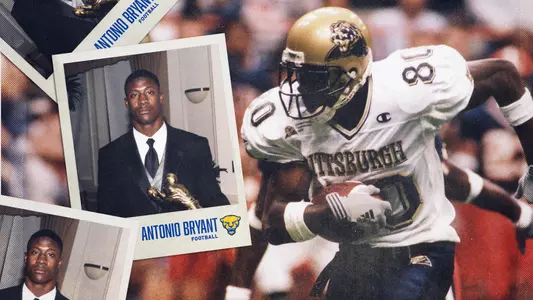
Antonio Bryant: The Last Pick Who Became The First Star
8/17/2026 6:01:00 PM | Football, General
He kept the newspaper.
During the week of the 2000 Backyard Brawl, a West Virginia defensive back named Richard Bryant told the Pittsburgh Post-Gazette he'd "be the best Bryant on the field come Saturday."
The paper ran it in bold type. Pitt's SID at the time, EJ Borghetti, remembers the headline word for word, all these years later.
Antonio Bryant remembers it too. He went out that day and torched the Mountaineers for more than 100 yards, including a highlight-reel touchdown where his shoe came off mid-route and he still got both feet in bounds.
Afterward, in the postgame scrum, someone lobbed him the obvious question: "I guess you showed the West Virginia secondary today?"
Bryant didn't say a word. He just reached into his pocket, pulled out the newspaper clipping he'd saved all week, and held it up.
"His play spoke for him," Borghetti said. "He didn't have to say anything more."
That was Antonio Bryant in one frame: quiet chip on the shoulder, loud answer on the field. It's the same pattern that carried him from the last name called in his own recruiting class to a Biletnikoff Award, a Pitt receiving record book he still owns pieces of, and — now — a place in the Pitt Athletics Hall of Fame.
The Last Guy Taken
Bryant's path to Pitt started with a "no."
He'd signed with Louisville out of high school, but the fit felt wrong the moment he really looked at it. Louisville wanted to redshirt him — reasonable, given he'd played receiver for exactly one season, his senior year at Miami's Northwestern High, after transferring in and switching positions cold.
Pitt didn't ask him to wait.
"I never sat on a bench," Bryant said. "I always was a starter. When I got back home from the visit, I remember telling my people like, 'Hey, I feel really good about Pitt.'"
There was another thread pulling him north: his high school teammate, running back Torrie Cox, was also headed to Pitt. The two had just won a Florida state title together, undefeated, in front of 46,000 fans at the Orange Bowl.
"He was quite famously the last guy taken in that recruiting class," Borghetti said. "But for those staff members who strongly advocated for him — boy, were they clairvoyant."
Borghetti said Bryant and Cox brought something Pitt had been missing at the tail end of the '90s: "tenaciousness and swagger... a Miami Northwestern refuse-to-lose mentality."
Bryant arrived on campus terrified, by his own admission. He was an 18-year-old dropped into a locker room of grown men. He couldn't sleep in his hotel room during his first camp. He dragged his mattress out to the lobby and slept behind the front desk instead. Nobody remembers whose idea that was. It just worked.
Learning the Position, One Punishment at a Time
Bryant's freshman year came with growing pains that had nothing to do with talent. His class schedule collided with practice, leaving no time for a nap before meetings. So, he fell asleep during film study. Repeatedly.
Offensive coordinator and wide receivers coach J.D. Brookhart's answer was to banish him to a side room with head coach Walt Harris and the QBs: Rod Rutherford, John Turman.
It was meant as a punishment. It became the turning point.
"That's when Coach Harris opened my mind up," Bryant said, "and helped me really transition to learning the offensive position and learning the game."
The bear-crawl punishments meant even less — Bryant had grown up doing them for fun in youth football. But the film room sessions with the quarterbacks taught him to see the game from the other side of the ball, and it accelerated everything.
By his freshman season, Bryant was already showing flashes nobody had scouted for. Against a top-five Virginia Tech team led by Heisman candidate Michael Vick, Bryant went toe-to-toe with the moment.
"The nation tuned in to see Mike Vick," Borghetti said, "But what they ultimately got was an Antonio Bryant show... that showed me that as a young freshman, he was not going to be intimidated by the bright lights."
The Sophomore Season Nobody Saw Coming
Bryant opens with a detail that puts his 2000 numbers in a different light entirely: he missed the season opener under suspension, then came back and — by his own recollection — led the nation in receiving the very next game.
He played nine games. He led the country in receiving yards anyway, averaging 130.2 per game.
"I didn't become aware of awards and acknowledgements... until my sophomore year," Bryant said. "Nobody ever had those conversations with me."
That changed fast. By December, he was in Orlando for the Biletnikoff Award ceremony. Bryant was one of the youngest players there, up against two established upperclassmen: Freddie Mitchell of UCLA and Marvin Minnis of Florida State.
Borghetti had a head start on the news. An ESPN Radio producer tipped him off hours before the announcement, sworn to secrecy.
But Bryant didn't think he had a chance due to his age.
"Someone came up to me and EJ, and the guy asked me, "So, what are you going to say if you win?" Bryant said. "That very moment, I said, 'Hmm, that's odd. Maybe I might win.' It still wasn't heavy on me. I wasn't too worried about it because I was one of the youngest guys there."
So when his name was called, he truly didn't see it coming. There was a second of shock across his face, but then he went back to being himself. He buttoned his jacket, walked to the stage and delivered a brief, genuine thanks.
It was Pitt's first major national positional award since the 1980s.
"That's when I personally thought, you know what — we are back," Borghetti said. "It made the public believe, and recruits believe, that whatever you aspire to, you can achieve it at Pitt."
A Fitting Final Frame
Bryant closed his Pitt career the way he'd played it: on the big stage, delivering. In the 2001 Tangerine Bowl against an NC State team led by Philip Rivers, Bryant caught seven passes for 101 yards and two touchdowns, earning MVP honors in a 34-19 win — Pitt's first bowl victory in 12 years.
"Big-time players show up in big-time games," Bryant said. "I feel like I went out as a winner as a little leaguer. I went out as a winner in high school. And then college — we didn't go undefeated, but we came back from some detrimental circumstances... and we swept through that thing."
Fans in the stands were chanting for one more year. Bryant chose the draft instead, and the Dallas Cowboys took him in the second round. He'd play seven NFL seasons, but he left Pitt having rewritten the receiving record book: 3,061 career yards, 30 touchdowns, both program bests at the time.
Bryant admits he never got a proper goodbye from football. No farewell tour, just a quiet stop. The Hall of Fame induction gave him something closer to closure.
"I never had a proper retirement from football," Bryant said. "I'm looking at it as an opportunity to close the chapter of football in my life completely and be at peace with that."
More than anything, he's proud to have been such a key part in the history of Pitt football.
"I just love that I was a part of the turning point," Bryant said. "I'm grateful that everybody felt the same way. Nobody wanted to be a part of something that wasn't unsuccessful. We bust our asses to be as successful as possible."