University of Pittsburgh Athletics
When Disaster Hit Home, Pitt Swim and Dive Answered
10/1/2026 5:05:00 PM | Swimming & Diving
Mariana Osorio Mendoza was supposed to be on vacation.
The Pitt swimming and diving sophomore was back home in Cali, Colombia, in early August, a couple weeks into a summer break before returning to Pittsburgh. It was supposed to be a quiet trip. Instead, on the morning of Aug. 10, she woke up to her house shaking.
Osorio Mendoza is used to feeling the ground move. Earthquakes aren't rare in Colombia. But this one was different. She got her family outside, where her father was already waiting with their two dogs, and couldn't help but notice truly how bad it was.
"We were next to our car and the car was bouncing up and down, and it was pretty scary," Osorio Mendoza said.
The power and water went out. Phone service died with it. For most of the day, she had no way to reach her mother, who was still at work when it hit.
By nightfall, the electricity came back, and so did the news.
The earthquake hadn't just rattled her neighborhood. It had leveled buildings across western Colombia, closer to the Pacific coast where the quake originated. The next day, Osorio Mendoza went with her father to one of the collapsed buildings to see if they could help.
What she found stuck with her: a structure folded in on itself floor by floor, rescue crews working fast and far more needed than two people could meet.
Back in Pittsburgh, her coaches found out through the news before she even had the chance to tell them. Director of the Swimming and Diving program Katie Kasprzak was one of the first to reach out, making sure Osorio Mendoza and her family were safe. Then she asked how to help.
"I didn't think that in that moment our help was going to be necessary, because the help was already a lot," Osorio Mendoza said.
What worried her instead was what comes weeks later, once the cameras and first responders move on and the rebuilding is just getting started.
So, Osorio Mendoza made a deliberate choice to wait before organizing anything.
"After something like that happens, it's a couple weeks later when people suffer the most," Osorio Mendoza said. "The help stops and they have to try to come back to their lives without anything."
Kasprzak wanted to do anything to help. She connected Osorio Mendoza with the right people when she was back on campus rather than take over the moment.
"I wanted her to really think about what we can do that's going to make an impact, that is going to help her support her country the best that she can," Kasprzak said.
She looped in Director of Community Engagement Celeste Walsh, who helped connect the team with Brother's Brother, and diver Jocelyn Brooks, who she could count on for support within the team.
Kasprzak wanted Osorio Mendoza to lead, but she also understood the position that put her in. Asking your own teammates for help is hard, especially for someone who describes herself as shy. Brooks became the bridge, someone who could make the early asks to the team so Osorio Mendoza wouldn't have to carry that alone.
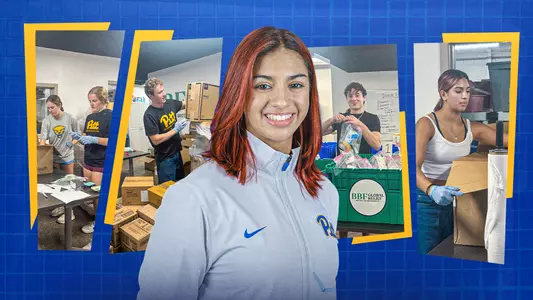
The plan came together around Brother's Brother, a Pittsburgh-based organization focused on disaster relief, health and education efforts around the world. The team raised more than $500, which went toward supplies at the organization's warehouse, and collected travel-size toiletries, hygiene products and clothing donations in the weeks that followed.
When it was time to assemble everything, many members of the team showed up.
Divided into small groups, they started by sorting through donated boxes, checking expiration dates on medical supplies and sorting out what couldn't be used.
From there, it turned into a production line. Each person was assigned a station, responsible for adding one item into a ziplock bag before passing it down to the next. Toothbrushes. Hygiene products. A makeshift first aid kit with bandages and gauze. The bags moved station to station until they reached the end of the line, sealed and ready.
What started as a logistics problem turned into something closer to a game, with some stations moving faster than others and plenty of ribbing about who was slowing down the line. By the end, the team had assembled 155 aid kits.
For Osorio Mendoza, the most meaningful part wasn't the number. It was watching teammates who have never been to Colombia, who have no connection to the country beyond her, show up anyway.
"It was pretty pretty cool to see," Osorio Mendoza said. "That's what a team is, right? We're not only like a swimming and diving team; we're also like a family that is gonna support each other, no matter what."
Kasprzak points to this situation as a reflection of how close-knit the swimming and diving program tries to be.
The team has done community service before, but she wants her athletes to know each other well enough that this kind of support happens naturally, not because of a spreadsheet of hours.
"Our athletes are more than just athletes to us," Kasprzak said. "Hopefully we don't experience catastrophes and natural disasters with anybody else, but it's why we can support Mariana and hopefully she feels so supported — because we have that relationship already."