University of Pittsburgh Athletics
Fueled by Courage
10/28/2022 4:02:00 PM | General, Women's Gymnastics
Helping to Lay the Foundation for Title IX
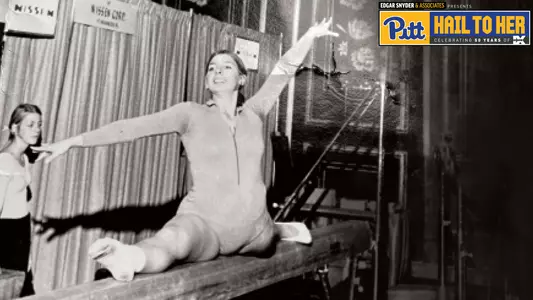
Donna DeMarino Sanft (EDUC '74, '89G) has witnessed firsthand the power of Title IX. As a first-year gymnast at the University of Pittsburgh in 1970, she competed in a regional competition and, after her portion of the competition was over, decided to stay longer to watch her peers and to learn more from some of the best in the country.
Donna was by herself and didn't even have a credit card for her expenses. "I don't know what I thought I was doing," she jokes. Fast-forward 52 years and Sanft, a longtime coach and administrator at Pitt, attends volleyball practice before Dan Fisher's team—fresh off a trip to the national semifinals—departs for an international trip where it will compete against teams in Spain and Italy.
"How great it is that these athletes can take advantage of these opportunities to see how good they can be," Sanft says. "There's been an awful lot of progress."
Clearly there has.
Sanft considers herself lucky. Growing up in the Westmoreland County, Pennsylvania, mill town of Monessen—once known as a bustling hotbed of high school football and basketball talent—she got involved in gymnastics at a young age.
Monessen was a rare place, one that backed female athletes and provided a meaningful platform for competition during a time when that was not the case throughout the region and the country.
"A lot of women my age didn't have that opportunity when they were growing up," she says. "People thought it was fine for us to do it."
Sanft admits that she wasn't the best gymnast on her high school team, which won four state championships and received a police escort when returning home with a trophy one year—a sign of respect not typically given to female athletes at the time. She was, however, good enough to attend Pitt, join the school's gymnastics team and perform under coaches Gail Santillo and Debbie Wells, who Sanft credits with working as hard as they could to provide opportunities to her and her teammates.
That said, when Sanft stepped on campus, women's athletics were still two years away from the introduction of Title IX in 1972. At Pitt, they were not considered part of the athletics department, falling instead under the auspices of the School of Education's physical education department.
"We had these really wonderful women who were faculty members in the physical education department and who were coaches of various teams," Sanft says. "They wanted us to have the opportunities. I am guessing that they were not compensated appropriately."
While faculty adding coaching duties to their resume was typical at colleges across the country at that time, and with only men's sports recognized and uplifted, Sanft couldn't help but feel the injustice.
"I had a little chip on my shoulder because I didn't grow up in an area where women's sports in general weren't respected or supported," she says. "That was a foreign concept to me. I didn't realize that the rest of the world was different."
So Sanft took action, writing letters to the Pitt athletics department and asking the University to invest more in women's athletics.
She followed the example of others, like Peg Covert, who was the head of women's sports while they were housed in the physical education department and pushed for equal sports facilities for women's and men's teams.
Covert led the school's first female cheerleading squad despite plenty of resistance and notoriously upset Pitt's administration by organizing a field hockey game on the lawn of the Cathedral of Learning.
"She was a champion for women's rights and did everything she could to promote women's sports prior to Title IX," Sanft says of Covert, who passed away in 2006.
Then, in 1972, Title IX passed, prohibiting colleges from sex-based discrimination, and the path toward equality was introduced.
Two years later, Pitt brought women's athletics into the University's athletics department.
Even still, there were hiccups. Women's sports across the country were naturally at a disadvantage when it came to funding and acceptance.
It was around then that Sanft finished her time as a competitor and was called in to discuss taking over as the gymnastics program's head coach. Pitt's athletic director at the time was Cas Myslinski, a former officer in the U.S. Air Force known for having a stern demeanor.
"I was very respectful, but I spoke up every now and then about situations, Sanft says. "Even so, he thought I could do the job, and I give him a lot of credit for hiring me. I was 22 years old."
Suddenly Sanft, like many women's coaches during that era, had to learn on the fly how to run an athletic program, from managing a budget to recruiting and handling all the varied responsibilities that head coaches shoulder.
"There were people willing to help, [to] stop for a second and give me a hand," says Sanft, who recalls the time she borrowed recruiting letters from men's assistant basketball coach Tim Grgurich to use as a template for her own program. And, she notes, administrators like Carol Sprague provided tremendous support.
"I asked for help when I needed it, and there were plenty of people who were interested in being helpful," she says. "Did I encounter some roadblocks? Yes. But instead of getting angry about it, it made me more motivated to get things done."
Sanft ended up coaching gymnastics at Pitt for 12 years and then went on to a long, successful career as an administrator in which she held numerous roles and was able to see Title IX's impact at Pitt and throughout the NCAA.
During her 41-year journey at Pitt, women's athletics programs received more and more funding, better facilities and more equality in terms of scholarship allotment and overall opportunity.
Programs such as Pitt's Cathy and John Pelusi Family Life Skills Program—which Sanft describes as a "labor of love"—began to pop up, serving as an outlet to help student-athletes develop outside the classroom or playing arena.
Now, 50 years after Title IX was introduced, the fight for equality is still ongoing.
Pitt, for instance, is one of only six of the 65 Power Five schools to have a woman serve as athletic director this year, and Heather Lyke is the first female to serve in the role in Pitt's history.
But Sanft, there for the groundwork of it all, recognizes that tremendous headway has been made.
"Pitt is doing a lot of things right in terms of providing support for all teams to pursue excellence and be competitive nationally," she says, echoing a familiar motto of Lyke's. "It's facilities, scholarships, coaching staffs, support services, nutrition, mental health, life skills and academic support.
"I honestly have felt that when it came to supporting student-athletes on a day-to-day basis, Pitt has always invested so much in the student-athlete experience."
Ten years ago, during the celebration of the 40th anniversary of Title IX, Sanft was a speaker at the Varsity Letter Club dinner.
She posed a pointed question to those in attendance.
"I'm guessing that all of you in the audience would agree that sports provided us the opportunity to test ourselves, to be tough and resilient, to go after our goals, to learn how to deal with failures and obstacles and how to overcome them, to become mentally and physically strong, to develop teamwork and leadership," she told the crowd.
"If those skills are so important for our sons, they have to be equally important for our daughters, don't they?"
The crowd nodded in unison.
Fifty years earlier, that question might have been received much differently. But the work and courage of those like Sanft, Covert, Santillo, Wells and countless others paved the way for female student-athletes today to feel what Sanft felt as a young girl in Monessen: valued. "We have to remember that all of the great things that sports can do for people are equally valuable for men and for women," she says. "Participating in sports can help all student-athletes develop skills that will benefit them throughout their lives."
Donna was by herself and didn't even have a credit card for her expenses. "I don't know what I thought I was doing," she jokes. Fast-forward 52 years and Sanft, a longtime coach and administrator at Pitt, attends volleyball practice before Dan Fisher's team—fresh off a trip to the national semifinals—departs for an international trip where it will compete against teams in Spain and Italy.
"How great it is that these athletes can take advantage of these opportunities to see how good they can be," Sanft says. "There's been an awful lot of progress."
Clearly there has.
Sanft considers herself lucky. Growing up in the Westmoreland County, Pennsylvania, mill town of Monessen—once known as a bustling hotbed of high school football and basketball talent—she got involved in gymnastics at a young age.
Monessen was a rare place, one that backed female athletes and provided a meaningful platform for competition during a time when that was not the case throughout the region and the country.
"A lot of women my age didn't have that opportunity when they were growing up," she says. "People thought it was fine for us to do it."
Sanft admits that she wasn't the best gymnast on her high school team, which won four state championships and received a police escort when returning home with a trophy one year—a sign of respect not typically given to female athletes at the time. She was, however, good enough to attend Pitt, join the school's gymnastics team and perform under coaches Gail Santillo and Debbie Wells, who Sanft credits with working as hard as they could to provide opportunities to her and her teammates.
That said, when Sanft stepped on campus, women's athletics were still two years away from the introduction of Title IX in 1972. At Pitt, they were not considered part of the athletics department, falling instead under the auspices of the School of Education's physical education department.
"We had these really wonderful women who were faculty members in the physical education department and who were coaches of various teams," Sanft says. "They wanted us to have the opportunities. I am guessing that they were not compensated appropriately."
While faculty adding coaching duties to their resume was typical at colleges across the country at that time, and with only men's sports recognized and uplifted, Sanft couldn't help but feel the injustice.
"I had a little chip on my shoulder because I didn't grow up in an area where women's sports in general weren't respected or supported," she says. "That was a foreign concept to me. I didn't realize that the rest of the world was different."
So Sanft took action, writing letters to the Pitt athletics department and asking the University to invest more in women's athletics.
She followed the example of others, like Peg Covert, who was the head of women's sports while they were housed in the physical education department and pushed for equal sports facilities for women's and men's teams.
Covert led the school's first female cheerleading squad despite plenty of resistance and notoriously upset Pitt's administration by organizing a field hockey game on the lawn of the Cathedral of Learning.
"She was a champion for women's rights and did everything she could to promote women's sports prior to Title IX," Sanft says of Covert, who passed away in 2006.
Then, in 1972, Title IX passed, prohibiting colleges from sex-based discrimination, and the path toward equality was introduced.
Two years later, Pitt brought women's athletics into the University's athletics department.
Even still, there were hiccups. Women's sports across the country were naturally at a disadvantage when it came to funding and acceptance.
It was around then that Sanft finished her time as a competitor and was called in to discuss taking over as the gymnastics program's head coach. Pitt's athletic director at the time was Cas Myslinski, a former officer in the U.S. Air Force known for having a stern demeanor.
"I was very respectful, but I spoke up every now and then about situations, Sanft says. "Even so, he thought I could do the job, and I give him a lot of credit for hiring me. I was 22 years old."
Suddenly Sanft, like many women's coaches during that era, had to learn on the fly how to run an athletic program, from managing a budget to recruiting and handling all the varied responsibilities that head coaches shoulder.
"There were people willing to help, [to] stop for a second and give me a hand," says Sanft, who recalls the time she borrowed recruiting letters from men's assistant basketball coach Tim Grgurich to use as a template for her own program. And, she notes, administrators like Carol Sprague provided tremendous support.
"I asked for help when I needed it, and there were plenty of people who were interested in being helpful," she says. "Did I encounter some roadblocks? Yes. But instead of getting angry about it, it made me more motivated to get things done."
Sanft ended up coaching gymnastics at Pitt for 12 years and then went on to a long, successful career as an administrator in which she held numerous roles and was able to see Title IX's impact at Pitt and throughout the NCAA.
During her 41-year journey at Pitt, women's athletics programs received more and more funding, better facilities and more equality in terms of scholarship allotment and overall opportunity.
Programs such as Pitt's Cathy and John Pelusi Family Life Skills Program—which Sanft describes as a "labor of love"—began to pop up, serving as an outlet to help student-athletes develop outside the classroom or playing arena.
Now, 50 years after Title IX was introduced, the fight for equality is still ongoing.
Pitt, for instance, is one of only six of the 65 Power Five schools to have a woman serve as athletic director this year, and Heather Lyke is the first female to serve in the role in Pitt's history.
But Sanft, there for the groundwork of it all, recognizes that tremendous headway has been made.
"Pitt is doing a lot of things right in terms of providing support for all teams to pursue excellence and be competitive nationally," she says, echoing a familiar motto of Lyke's. "It's facilities, scholarships, coaching staffs, support services, nutrition, mental health, life skills and academic support.
"I honestly have felt that when it came to supporting student-athletes on a day-to-day basis, Pitt has always invested so much in the student-athlete experience."
Ten years ago, during the celebration of the 40th anniversary of Title IX, Sanft was a speaker at the Varsity Letter Club dinner.
She posed a pointed question to those in attendance.
"I'm guessing that all of you in the audience would agree that sports provided us the opportunity to test ourselves, to be tough and resilient, to go after our goals, to learn how to deal with failures and obstacles and how to overcome them, to become mentally and physically strong, to develop teamwork and leadership," she told the crowd.
"If those skills are so important for our sons, they have to be equally important for our daughters, don't they?"
The crowd nodded in unison.
Fifty years earlier, that question might have been received much differently. But the work and courage of those like Sanft, Covert, Santillo, Wells and countless others paved the way for female student-athletes today to feel what Sanft felt as a young girl in Monessen: valued. "We have to remember that all of the great things that sports can do for people are equally valuable for men and for women," she says. "Participating in sports can help all student-athletes develop skills that will benefit them throughout their lives."


Tuesday, January 23
Friday, April 28
Wednesday, March 31
Wednesday, March 31