University of Pittsburgh Athletics
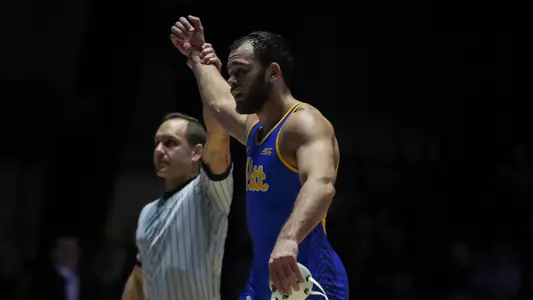
4/24/2020 8:55:00 AM | Wrestling
As cliché as a rags to riches trope has become, it also pertains to a greater truth that reflects on the ideals of our culture and how it has come to define success. Rising from the pool of silent voices to overcome the disparity in being less fortunate is a small percentage that manages to escape their own circumstances. Take my own life for example; I have a male figure that fits perfectly into this small percentage giving me a unique, third party point of view into the link between this eager drive resulting from a preceding childhood that was rich with character building experiences, yet underwhelming materially, and how it echoes within the man I have become today—he is my father.
I was 10 years old and in the middle of my third grade school year when I first realized that the world I lived in wasn't entirely nice, but rather it existed in a very different way depending on who you were. I checked out a library book about Muhammad Ali—dissecting each page image by image while trying to wrap my mind around the greatness that he embodied. My father and I have always had a relationship that partly revolved around athletics and it seemed natural to approach him about something I saw. When I reached the section of the book about Ali's social influences, it was my first encounter with the N word. I asked my dad what it meant. "Derogatory" did not suffice as an answer, but even at 10 I could sense his body language and the life that drained from his eyes. The sound of it sliced through the air as it entered my ears from the letters printed on the page.
When he was my age, that single word determined so much—whether he was fighting that day or he could be just a little kid. The source of so much hate—adult things like honor and pride. It was my first encounter with the side of human nature as it pertained to my own lineage. There I was standing in front of him with the wide-eyed curiosity that only young boys carry having just asked such a loaded question with an honest audacity. I looked as he pandered for the right words to explain to his son what it meant to him and why it should matter to me.
Making it out of a situation where not many people do requires a vehicle. For him, wrestling was the avenue that allowed him to grow. On his way to becoming a four-time All-American at the Division 1 level, many of the hard lessons he learned growing up still persisted. Wrestling for me had many less implications; it was his job to simulate the toughness that it took to survive and thrive in the world we lived in.
I take a long, hard look at myself in the mirror—past the facial similarities and the bit of pigment I have in my skin. Past what I conceived to be challenges in my own life and any notions I have had of being poor previously, too. Delving deeper into my father's childhood reminds me of the dangers of comparison. Stack my own accomplishments against his and I pale. I feel like a visitor in my own skin when I weigh the frictionless suburban childhood I was raised to the largely independent, paycheck-to-paycheck, racially tense upbringing of my father who endured it –and succeeded.
I learned that almost every family has examples of adversity, or otherwise some other example of a blaring disadvantage somewhere along the line—whether that is financial shortcomings, the color of your skin, or both. But there is merit in being the little man too. It isn't about comparison, but rather, about growth. The more genuine testament to whether you "made it" lies somewhere in where and how you apply the experiences you lived through during those times of discomfort. Again, looking inward, I begin to recognize the series of pseudo-challenges that were placed in my life to compensate for my upper middle class town's leisurely pace. Wrestling was what he knew. Deeper than that, it is a great metaphor for some of future experience I will certainly find myself in where conditions are stacked against me. I would be lying if I said it was always fun. I do not look back fondly on all of the training, but with the right perspective, I can derive a great deal of worth from pushing through some adverse times.
I find it easy to resort to thinking that in some way the outcomes of wrestling matches tied into my identity. In my mind, whether or not I took first place had some bearing over the man I will inevitably become. Now that I have finished competing in wrestling, reflection has landed me in a space that has found that no one thing can define my identity. I'm not a "wrestler"; it is just something I did. The grit and toughness it taught me contribute to the person I have become.
My father used tough love to supplement the fact that I didn't have the same upbringing—my ideals about man still largely in tact and my goals still lofty and somewhat nauseating. Lessons about grit and toughness through wrestling were all metaphors for some of the harsh realities that I was missing being surrounded by the environment that I was. For that, I am eternally grateful.
Thanks, Dad.
I was 10 years old and in the middle of my third grade school year when I first realized that the world I lived in wasn't entirely nice, but rather it existed in a very different way depending on who you were. I checked out a library book about Muhammad Ali—dissecting each page image by image while trying to wrap my mind around the greatness that he embodied. My father and I have always had a relationship that partly revolved around athletics and it seemed natural to approach him about something I saw. When I reached the section of the book about Ali's social influences, it was my first encounter with the N word. I asked my dad what it meant. "Derogatory" did not suffice as an answer, but even at 10 I could sense his body language and the life that drained from his eyes. The sound of it sliced through the air as it entered my ears from the letters printed on the page.
When he was my age, that single word determined so much—whether he was fighting that day or he could be just a little kid. The source of so much hate—adult things like honor and pride. It was my first encounter with the side of human nature as it pertained to my own lineage. There I was standing in front of him with the wide-eyed curiosity that only young boys carry having just asked such a loaded question with an honest audacity. I looked as he pandered for the right words to explain to his son what it meant to him and why it should matter to me.
Making it out of a situation where not many people do requires a vehicle. For him, wrestling was the avenue that allowed him to grow. On his way to becoming a four-time All-American at the Division 1 level, many of the hard lessons he learned growing up still persisted. Wrestling for me had many less implications; it was his job to simulate the toughness that it took to survive and thrive in the world we lived in.
I take a long, hard look at myself in the mirror—past the facial similarities and the bit of pigment I have in my skin. Past what I conceived to be challenges in my own life and any notions I have had of being poor previously, too. Delving deeper into my father's childhood reminds me of the dangers of comparison. Stack my own accomplishments against his and I pale. I feel like a visitor in my own skin when I weigh the frictionless suburban childhood I was raised to the largely independent, paycheck-to-paycheck, racially tense upbringing of my father who endured it –and succeeded.
I learned that almost every family has examples of adversity, or otherwise some other example of a blaring disadvantage somewhere along the line—whether that is financial shortcomings, the color of your skin, or both. But there is merit in being the little man too. It isn't about comparison, but rather, about growth. The more genuine testament to whether you "made it" lies somewhere in where and how you apply the experiences you lived through during those times of discomfort. Again, looking inward, I begin to recognize the series of pseudo-challenges that were placed in my life to compensate for my upper middle class town's leisurely pace. Wrestling was what he knew. Deeper than that, it is a great metaphor for some of future experience I will certainly find myself in where conditions are stacked against me. I would be lying if I said it was always fun. I do not look back fondly on all of the training, but with the right perspective, I can derive a great deal of worth from pushing through some adverse times.
I find it easy to resort to thinking that in some way the outcomes of wrestling matches tied into my identity. In my mind, whether or not I took first place had some bearing over the man I will inevitably become. Now that I have finished competing in wrestling, reflection has landed me in a space that has found that no one thing can define my identity. I'm not a "wrestler"; it is just something I did. The grit and toughness it taught me contribute to the person I have become.
My father used tough love to supplement the fact that I didn't have the same upbringing—my ideals about man still largely in tact and my goals still lofty and somewhat nauseating. Lessons about grit and toughness through wrestling were all metaphors for some of the harsh realities that I was missing being surrounded by the environment that I was. For that, I am eternally grateful.
Thanks, Dad.


Saturday, March 01
Friday, February 07
Sunday, February 02
Saturday, February 01