University of Pittsburgh Athletics
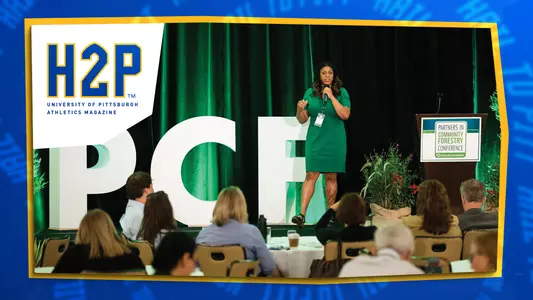
Coaching and Leading Away from the Game
1/31/2025 1:00:00 PM | General
Sports can nurture and strengthen certain traits, making what many see as leisurely activities as much of a character-building exercise as a competitive pursuit. Sports necessitate discipline. They teach structure. They require teamwork, even in more individualized competitions. The lessons learned on a field or court or inside a gym or pool can help to prepare someone for challenges and situations they may face in their life or career.
It’s something three former University of Pittsburgh female student-athletes know well. After their time at Pitt, these Panthers have gone from being leaders on their teams to leaders in the world of business, where they have used their ingenuity, determination and drive to help build companies from scratch.
Once standout players, these individuals are now, in some sense, coaches. But rather than standing on a sideline with a whistle draped around their neck, barking instructions to those under their supervision, they’re breaking new ground, pursuing their passions and forging a future entirely of their own creation.
Here are some of their stories.
Carolyne Savini (A&S ’04)

After graduating from Pitt in 2004 armed with several school swimming records as well as her diploma, Carolyne Savini carried with her a dream: She wanted to be a college athletic director.
Shortly after getting to Ohio University, where she earned her master’s in sports administration, her plans changed. Upon meeting a graduate of the program in which she was enrolled who had an executive search firm, Savini went from being someone who would lead a college athletic department to someone potentially tasked with finding that leader.
“What I thought might be an 18-36-month job for me turned into a career,” Savini says.
Today, 20 years after her Pitt graduation, Savini is now her own boss. In April, she officially launched The Catalyst Executive, an executive coaching and leadership development firm that aims to “reimagine how we develop, promote, and support executive talent as they navigate challenges and opportunities in business and life,” according to its website.
The firm offers executive coaching, leadership development, succession planning, onboarding support and assessment and leader development programming, among other services. Put more succinctly, Savini says that The Catalyst Executive’s goal is “bringing more exceptional leadership into the world.”
When it comes to leadership, Savini can speak from experience.
Following a decorated swimming career at Pitt, in which she set several school records and was an honorable mention All-American, and after earning her master’s degree, Savini embarked on a lengthy and accomplished career in executive recruiting. She worked for 12 years with TurnkeyZRG, an executive search firm in the sports and entertainment sphere, before moving on to another firm, Nolan Partners, and eventually ending up at Activision Blizzard, an American video game holding company, where she worked in executive practice and talent management for three and a half years.
Over that time, she worked with the likes of the NBA, Washington Nationals, Milwaukee Bucks, Kansas City Chiefs, Tampa Bay Buccaneers, Miami Dolphins, U.S. Tennis Association, National Women’s Soccer League and Super Bowl XLVIII host committee.
For all the success she found, she envisioned a different kind of future for herself. Even in her days at Turnkey, she knew that one day she wanted to launch her own business.
“I knew from having worked in a small business that I could do this, too,” she says. “It’s not rocket science. I had a desire to be an entrepreneur and have my own business. That was percolating in the back of my mind. Quite frankly, while I kind of assumed that someday I would launch my own executive search firm, it’s in part because it’s what I knew, but not necessarily what I felt like the world needed. Truth be told, my sector of the sports industry doesn’t need another executive recruiting firm. There’s a ton out there now compared to when I first started doing it.”
The need for building great leaders rather than finding and recruiting them was made even more urgent for Savini after her time at Activision, which faced a lawsuit for allegedly fostering a culture of sexual harassment near the end of her time there. Though Savini didn’t personally experience any of the misdeeds at the center of the lawsuit, her time at Activision showed her that large companies can have “black holes sucking the life out of what I consider to be great leadership.”
“That got me really passionate about, broadly, what makes a great leader and all the things that are wrapped up into it,” she says.
Starting a new business can be an onerous endeavor, but it’s one that doesn’t overwhelm Savini. Her swimming career, complete with 5 a.m. alarms for morning practices, taught her the importance of discipline and time management, particularly at Pitt, where she says she felt “like I came alive.”
Her time building up The Catalyst Executive has reinforced something else for Savini: When you’re truly passionate about something, even the most rigorous tasks don’t feel like work.
“The love for it makes the hard tasks feel different,” she says. “What might seem really challenging or really difficult or the thought of why would anyone want to do this—it brings a whole different experience into it.”
Alisa Spector Angelo (A&S '87)

While working toward her MBA at the University of Massachusetts Amherst, Alisa Spector Angelo came to a jarring realization.
As rigorous as her program was, and as much as she enjoyed certain facets of it, it was focused overwhelmingly on the numbers and data of business rather than the people who work within the system.
“Unless you’re going to be in an organization of one, you need people to help you,” she says. “How do you get people aligned, and how do you get people to do the work and execute? There was nothing on communications. How do you message? How do you persuade? How do you get people excited? All those things, whether you’re talking internally or to investors or whoever, were completely lacking from the curriculum. There was such a missing space.”
Even if she didn’t necessarily know it in the moment, that revelation would come to define her professional life.
Spector Angelo is the founder and president of Compass Business Solutions, Inc., a consulting firm that specializes in driving “organizational performance through proven business and people strategies.”
“Each one of us at Compass, gets up every morning and is energized by helping clients create workplaces where their people can thrive,” Spector Angelo says. “That involves a lot of different things. That includes having the right leadership tools to be strong leaders. That requires the right policies, the right procedures, helping our teams to perform at their best in training and development. There are all different pieces to that employee experience, and that’s what my company does. How do we create these environments that people can perform their best in?”
Years before Compass was born, Spector Angelo grew to understand how genuine, sometimes overlooked, relationships between humans can elevate performance.
Spector Angelo was a gymnast at Pitt in the mid-1980s, earning NCAA All-Region recognition three times over the course of her collegiate career. While there, she forged a strong bond with Donna Sanft, who was her coach for three years before embarking on a trailblazing career in the University’s athletic department. They remain close today: Sanft, a Pitt Athletics Hall of Famer, occasionally lends her expertise on consulting projects at Compass.
“Like any great leader, she was able to see what I couldn’t see in myself to help me to be my best,” Spector Angelo says. “That goes for both inside the gym and in life.”
While studying at UMass, she became enamored with her organizational development class. She would take the motivational theories she was taught in the classroom and apply them to her job helping to coach the school’s gymnastics team.

As she saw those lessons applied successfully in the real world, the idea behind Compass and Spector Angelo’s career was born.
“That was sort of the biggest ‘aha’ moment: In order to spark people’s performance, you really have to understand them individually and as a team,” she says.
Compass came from humble origins.
After working in human resources at several companies, Spector Angelo started her business as a single consultant. In 2017, she bought out her partner and became Compass’ sole owner. In the years since, the firm has grown considerably, with 15 consultants under its umbrella and offices in Pittsburgh; Los Angeles, California; and Orlando, Florida.
Over the course of its existence, the firm has assisted a broad base of clients, from start-ups to Fortune 500 companies in industries like health care, technology, manufacturing, energy and professional sports. Spector Angelo says that the most rewarding part of that journey had been the feedback from employees at companies that once had “very toxic” internal cultures before being transformed into something more tenable and productive after their work with Compass.
In many ways, Spector Angelo ties her current life as a consultant back to her time as a gymnast. Though she was in a sport in which athletes were judged individually, their scores contributed to the success of a larger team. She understands the dynamics of winning organizations and how seemingly disparate parts must come together to make that success possible. She’ll often explain her work that way to executives: Success in business, like in sports, is all about having the right talent and knowing how to harness it.
“All those things that happened at Pitt really did influence many of the things that I think about still today,” she says.
Sarah Anderson Sewell (A&S ’11)
For Sarah Sewell, a job has never just been a job.
Throughout her professional career, and even before she graduated from Pitt in 2011, she has sought work that is less an occupation and more of a calling.
Her passion for service led her to earning her master’s degree in public administration from Bowie State University. Now she’s working to help others answer the call to serve their communities, too.
Sewell, a former track and field athlete at Pitt, is the founder and owner of Edit Genie, a company that provides on-demand consulting services to mission-driven professionals—or, as Sewell puts it, her venture helps to “make missions magical.”
“A lot of times, folks do mission work, and they’re really driven by what they’re doing,” Sewell (née Anderson) says. Alisa is surrounded by her dynamic team of business experts, each of whom drive organizational performance and strategic guidance to their clients.
“They’re so driven that many of the supports that enable them to do what they’re doing—securing grants or contracts, being able to codify agreements with other partners, making sure their organizational documents are together, optimizing for impact—can often go by the wayside when knee-deep in the work. Folks just barrel through much of the time. What I do at Edit Genie is stand up all the infrastructure around those doing mission-guided work so clients can stay focused and leave the administration to me.”
Edit Genie offers a valuable service assisting with the kinds of projects with which Sewell has significant experience but that can be daunting for many others. Among other undertakings, it helps with ghostwriting and editing, policy and program revamp, agreement and contract review and grant proposal and report curation.
The company launched earlier this year and is actually Sewell’s second business in what’s still a relatively young, burgeoning career. From 2015 to 2023, she was the CEO of Lillie Leaf Solutions, a consulting firm that supported environmental stakeholders from grassroots to government (with the name for the firm coming from her middle name, Lillie).
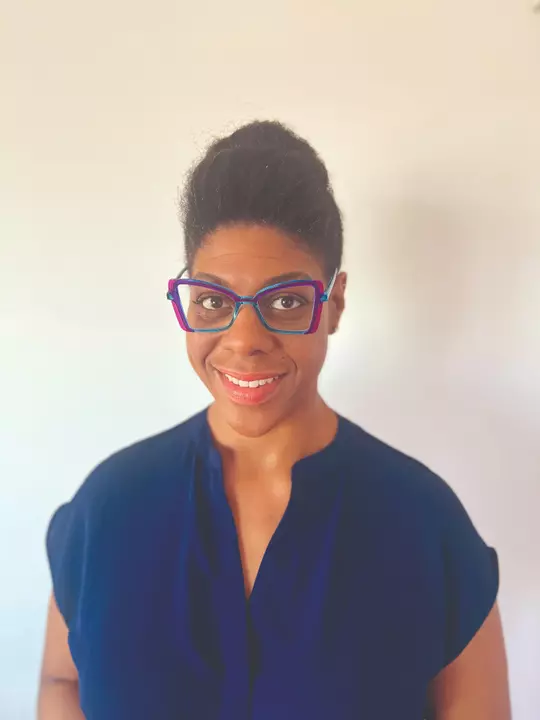
In her time working in the nonprofit sector, which also included stints at American Forests and City Parks Alliance, Sewell picked up a number of valuable skills that she now uses to help others through Edit Genie. For instance, she worked on federal grants, and she helped to author state and national policy, with some of her drafted legislation even finding its way into the Inflation Reduction Act of 2022.
During a recent two-year stint working in technology as a workforce program director, her eyes were opened even more to just how valuable a service like Edit Genie could be.
“Things really clicked for me. Some things are just consistent no matter what industry you’re in, no matter what sector you represent,” she says. “Folks have the same challenges. Everybody needs grant funding. Everybody needs standard operating procedures. Folks are all looking to make change via programs and policies to improve the lives of those they’ve committed to serving.”
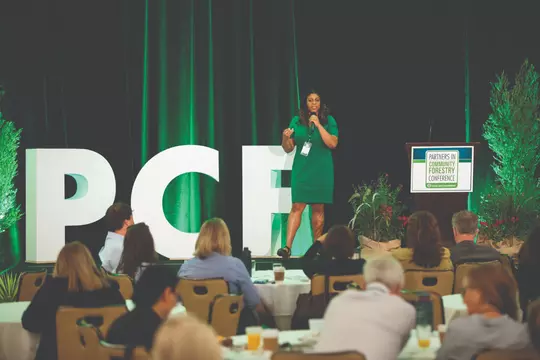
Sewell’s dedication to helping others and striving for the greater good goes back to her time at Pitt.
A New Jersey native, she arrived at Pitt as a walk-on for the track and field team as a thrower, be it for the hammer throw, discus or shot put. Her hard work and athletic successes ultimately earned her a scholarship for her final two years of college.
While attending Pitt, she volunteered with the StudentAthlete Advisory Committee and was elected president her junior and senior years. During her summers, she supervised a recreation program for low-income children in Mount Holly, New Jersey, that provided them with lunch and a snack during a time of year when they were out of school.
In the work she has done since then, Sewell sees a parallel with track and field. While many can mistakenly view it as an individual sport, it’s actually a team venture, with dozens of athletes pitching in however they can to help the squad move in a positive direction. It’s something that’s continually at the front of her mind as she works to grow Edit Genie in its nascent stage.
“It’s yin and yang,” Sewell said. “We need each other in order to create a just and harmonious society that works for everyone. Much of my career is closing the gap between current operations and our dreams for the future through realizing present potential. That’s the most rewarding part of my job: putting my skill set in service of others’ missions to create some magic, and engineering the conditions for future success together.”
Though they work in different industries and competed in different sports, Savini, Spector Angelo and Sewell are connected by their shared experiences as student-athletes at Pitt.
For many, college is a formative experience, a time when an unrefined teenager becomes something at least vaguely resembling a functioning adult by the time they graduate. For those tasked with balancing their academic workloads with the rigorous demands of being a Division I athlete, it’s an especially instructive period.
The lessons Savini, Spector Angelo and Sewell picked up during their athletic careers with the Panthers are ones that remain with them today. They’re all CEOs and proud Pitt alums, two labels that have been inextricably linked while they’ve achieved the success they’ve created for themselves.